
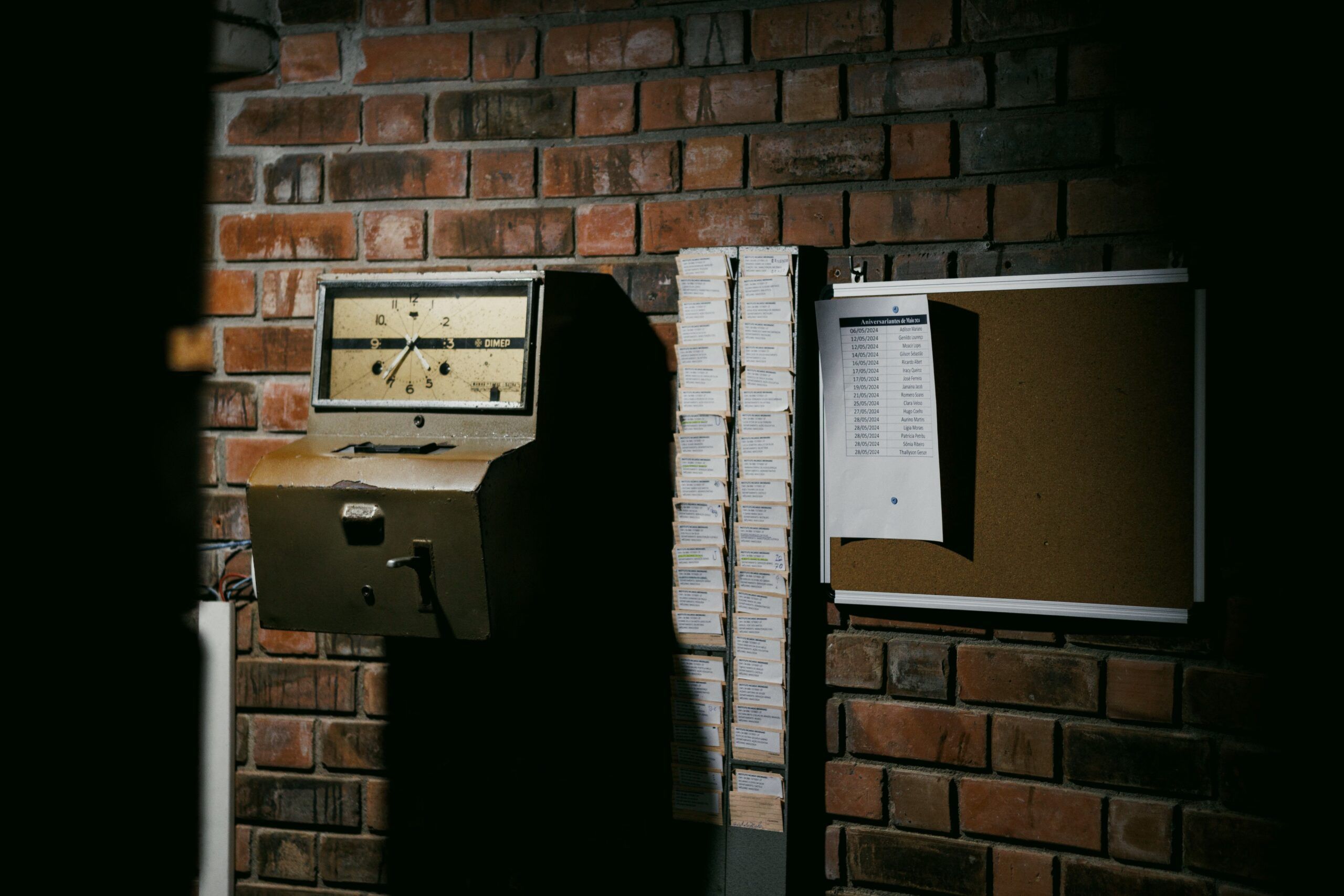
A company based in Venlo opens a branch in Mönchengladbach. Its HR department has so far recorded working hours in a spreadsheet that employees fill in themselves at regular intervals. Can the same procedure be kept for the German branch?
For now, in principle, yes – provided the required working hours are recorded in full. In future, however, that may no longer be enough. In the Netherlands, the Arbeidstijdenwet requires a proper registration but leaves its form open, so a spreadsheet can suffice. Germany also already has a duty to record working time. Under the draft bill published by the Federal Ministry of Labour in June 2026, however, recording is in future to be electronic as a rule and to take place on the day the work is performed.
Both legal systems must meet the same requirements under EU law. In 2019, the Court of Justice of the European Union ruled that employers must set up an objective, reliable and accessible system for recording daily working time. Germany and the Netherlands implement this requirement in different ways.
Germany: the duty to record exists, the form is still free
On 13 September 2022, the Federal Labour Court ruled that employers are obliged under Section 3(2) no. 1 of the Occupational Safety and Health Act to introduce a system for recording the working time performed. The ruling rests on an interpretation of the Act in line with EU law, taking into account the CJEU judgment of 14 May 2019 in Case C-55/18.
Since then, the start, end and duration of daily working time must be recorded. No particular form is prescribed so far. According to the guidance of the Federal Ministry of Labour, records may therefore also be kept in writing.
The employer may delegate the recording to its employees, but the company remains responsible for compliance with the legal requirements. Trust-based working time also remains possible, provided that maximum working hours and rest periods in particular are respected.
In addition, the Working Hours Act already contains its own recording duty. Under Section 16(2) ArbZG, working time exceeding eight hours on a working day in particular must currently be documented. These records must be kept for two years. Under Section 22 ArbZG, breaches can be punished as an administrative offence with a fine of up to 30,000 euros.
By contrast, the broader recording duty under the Occupational Safety and Health Act has no fine of its own. The competent authority must first issue a specific order; only a breach of that order can be sanctioned.
What the draft bill is set to change
The coalition agreement provides for the duty to record working time to be written into the Working Hours Act explicitly as an electronic recording duty. On 18 June 2026, the Federal Ministry of Labour presented a draft bill to that end.
At its core, the new Section 16 ArbZG is to provide for the following:
- Electronic, same-day recording: the start, end and duration of daily working time are as a rule to be recorded electronically on the day the work is performed. Recording can still be delegated to employees.
- Permanent exemptions: employers with up to ten employees and private households are to remain exempt from electronic recording.
- Transition periods: after entry into force, a transition period is to apply to all employers at first. Smaller companies are to receive additional transition time.
- Retention and access: records are to be kept for at least two years. Employees are also to be able to request information about their data and a copy.
- Fines: missing, incorrect, incomplete or late records are to be expressly classed as administrative offences.
The draft also provides for moving, under certain conditions, from a daily to a weekly view of maximum working time. This would require a collective agreement that at the same time safeguards health protection.
As of early September 2026, the draft is still being coordinated within the federal government. There is no cabinet decision yet, and some transition periods have not been finally set in the draft. Until new legislation is passed, the case law of the Federal Labour Court remains decisive.
The Netherlands: a registration duty since 1996, but no prescribed form
In the Netherlands, a statutory duty to record working time has existed since 1 January 1996. Article 4:3 of the Arbeidstijdenwet obliges employers to keep a proper registration of working and rest times. The records must be kept in a way that allows compliance with the Act to be checked.
A work instruction of the Netherlands Labour Authority dated September 2025 specifies these requirements. In particular, the actual start and end times, the assignment to individual employees, breaks and information on on-call duties must be recorded.
The Act does not, as a rule, prescribe which technical form companies use. Paper records, spreadsheets or dedicated software can therefore all be permissible, provided the necessary data are documented completely and traceably.
Under Article 3.2:1 of the Arbeidstijdenbesluit, the records must as a rule be kept for 52 weeks.
A further difference from Germany concerns personal scope. Under Article 2.1:1 of the Arbeidstijdenbesluit, the working time and registration rules do not apply, under certain conditions, to employees whose pay is at least three times the statutory minimum wage. This exemption does not apply, in particular, where night work or especially hazardous work is performed.
As a result, parts of the management level in the Netherlands are exempt from the relevant rules. The German recording duty, by contrast, in principle covers all employees to whom the Occupational Safety and Health Act applies.
Fines for missing working time records
The Netherlands Labour Authority applies fixed standard amounts to breaches. For a missing or inadequate working time registration, the base amount is 10,000 euros, adjusted according to company size:
- fewer than 10 employees: 5,000 euros
- 10 to 49 employees: 7,500 euros
- 50 to 99 employees: 10,000 euros
- 100 employees or more: 15,000 euros
For repeated breaches, the fine can increase by 100 to 200 per cent.
In Germany, the fine for breaches of the recording duty that is already sanctioned today under Section 22 ArbZG can reach 30,000 euros. Whether this range will change as part of the planned reform is left open in the draft so far.
What this means for companies with staff in both countries
For companies operating across the border, a single electronic time recording system can make sense. If set up accordingly, it can cover the requirements of both legal systems and at the same time prepare for the planned German rules.
Companies that have so far used paper lists or spreadsheets in the Netherlands can in principle continue to do so there. For a German branch, however, electronic recording could become necessary once the reform enters into force. Under the current draft, the applicable transition period depends on company size.
The rules on retention also differ. In the Netherlands, the regular period is 52 weeks; in Germany, two years apply to the relevant working time records.
Competent supervisory authorities
In Germany, the occupational safety and health authorities of the federal states monitor compliance with occupational safety and working time law. Depending on the state, this task is carried out mainly by trade inspectorates or comparable authorities.
In the Netherlands, the Netherlands Labour Authority is responsible. It monitors compliance with the Arbeidstijdenwet and imposes fines for breaches under the relevant Dutch rules.
Outlook
The two countries follow different models for recording working time. The Netherlands has had a statutory registration duty since 1996 but largely refrains from prescribing its technical form. Germany first shaped the general recording duty through case law and now intends to set it out expressly in the Working Hours Act.
Should the draft become law in its current basic structure, electronic, same-day recording is likely to be the most important change for many companies. It remains open, however, when the law will be passed and which transition periods will ultimately apply.
Until then, the current legal position stands: in Germany, the general duty to record working time continues to follow the case law of the Federal Labour Court. In the Netherlands, the long-established statutory registration duty applies.
References
Bundesarbeitsgericht (2022). Press release 35/22 on the decision of 13 September 2022, 1 ABR 22/21. Retrieved from https://www.bundesarbeitsgericht.de/presse/einfuehrung-elektronischer-zeiterfassung-initiativrecht-des-betriebsrats/
Bundesarbeitsgericht (2022). Decision of 13 September 2022, 1 ABR 22/21, full text. Retrieved from https://www.bundesarbeitsgericht.de/wp-content/uploads/2022/12/1-ABR-22-21.pdf
Court of Justice of the European Union (2019). Judgment of 14 May 2019, Case C-55/18, CCOO. Retrieved from https://curia.europa.eu/juris/liste.jsf?num=C-55/18
Gesetze im Internet (2026). Arbeitsschutzgesetz (ArbSchG), Section 3. Retrieved from https://www.gesetze-im-internet.de/arbschg/__3.html
Gesetze im Internet (2026). Arbeitszeitgesetz (ArbZG), Section 16. Retrieved from https://www.gesetze-im-internet.de/arbzg/__16.html
Gesetze im Internet (2026). Arbeitszeitgesetz (ArbZG), Section 22. Retrieved from https://www.gesetze-im-internet.de/arbzg/__22.html
Federal Ministry of Labour and Social Affairs (2025). Fragen und Antworten zur Arbeitszeiterfassung, as of 8 August 2025. Retrieved from https://www.bmas.de/DE/Arbeit/Arbeitsrecht/Arbeitnehmerrechte/Regelungen-zur-Arbeitszeit/Fragen-und-Antworten/faq-arbeitszeiterfassung.html
Federal Ministry of Labour and Social Affairs (2026). Draft bill amending the Working Hours Act and other provisions, 18 June 2026. Retrieved from https://table.media/assets/berlin/arbeitszeit_bmas.pdf
Overheid.nl (2026). Arbeidstijdenwet, Article 4:3. Retrieved from https://wetten.overheid.nl/BWBR0007671/2026-01-01
Overheid.nl (2026). Arbeidstijdenbesluit, Articles 2.1:1 and 3.2:1. Retrieved from https://wetten.overheid.nl/BWBR0007687/2026-01-01
Nederlandse Arbeidsinspectie (2025). Werkinstructie Arbeidstijdenwet, 2 September 2025. Retrieved from https://www.nlarbeidsinspectie.nl/site/binaries/site-content/collections/documents/2025/09/02/werkinstructie-arbeidstijdenwet/werkinstructie-arbeidstijdenwet-20250902.pdf
Nederlandse Arbeidsinspectie (2026). Boetebedragen bij overtredingen Arbeidstijdenwet. Retrieved from https://www.nlarbeidsinspectie.nl/nederlandse-arbeidsinspectie/sancties-en-handhavingsmethoden/boete/boetes-atw
Photo: Vitor Diniz / Pexels.